

Once a product developer has settled on a knit base over woven, the next decision is which knit construction to specify — and “single jersey” or “double knit” on a tech pack changes the garment’s stretch, opacity, and structure more than almost any other single spec choice. Getting this wrong is a common reason first-run samples come back too sheer, too heavy, or without the recovery a design called for.
This guide breaks down the structural difference between single jersey and double knit fabric, and which garment categories each one is actually built for.
Key Takeaways
- Single jersey is knitted from one set of needles in one direction, producing a lightweight, highly stretchable fabric with a distinct face and back side.
- Double knit is knitted using two sets of needles, producing a thicker, more stable, less sheer fabric with matching faces on both sides.
- These construction categories are part of the formal vocabulary defined in ASTM D123, Standard Terminology Relating to Textiles, which keeps the terms consistent across suppliers.
- Construction choice interacts directly with fabric weight — see the beginner’s guide to fabric GSM for how gauge and construction together determine final GSM.
Single Jersey: Lightweight, Stretchable, Directional
Single jersey is produced on a single needle bed, creating a fabric with a distinctly different face (smooth, flat loops) and back (more textured, purl-like loops). Because it’s built from a single layer of interlocking loops, single jersey is lightweight, highly stretchable, and relatively sheer at lower GSM — which makes it a natural fit for T-shirts, lightweight base layers, and any garment where drape and stretch matter more than structure or opacity.
Double Knit: Stable, Opaque, Structured
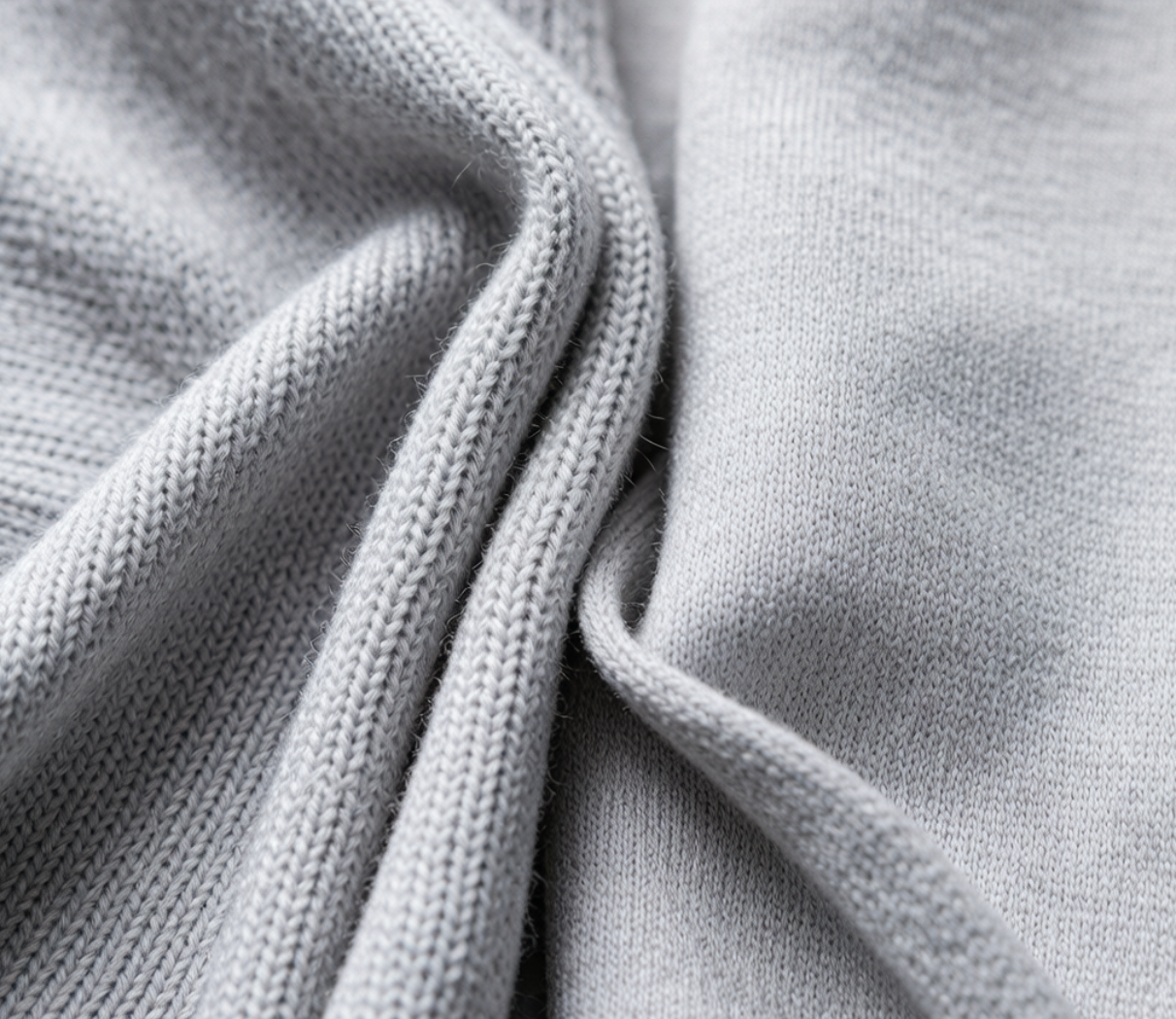
Double knit fabric is produced using two sets of needles working together, interlocking two layers of loops into one cohesive fabric. The result has matching faces on both sides, more dimensional stability, and significantly better opacity at a given weight compared to single jersey — which is why double knit is the default choice for leggings, structured polos, and any garment where see-through fabric is a functional failure, not just an aesthetic issue. Our breakdown of what is opaque fabric and why it matters for light-color apparel goes deeper into the opacity question specifically.
Comparing the Two Constructions Directly
| Property | Single Jersey | Double Knit |
|---|---|---|
| Structure | One needle bed, one layer | Two needle beds, interlocked layers |
| Face vs. back | Visibly different | Matching on both sides |
| Stretch | Higher | Moderate, more stable |
| Opacity at equal GSM | Lower | Higher |
| Typical use | T-shirts, lightweight base layers | Leggings, structured polos, higher-stability garments |
How to Choose Between Them for a New Style
- If the garment prioritizes stretch, drape, and lightweight feel — single jersey is the default starting point.
- If the garment prioritizes opacity, structure, and shape retention — double knit is the safer choice.
- If opacity is a hard requirement (e.g., a light-colored legging), don’t try to solve it purely by increasing single jersey’s GSM — evaluate double knit first.
- Either construction can carry the same functional finishes and fiber engineering — see what is performance knit fabric: a complete guide for apparel brands for how fiber, yarn, and structure combine.
Frequently Asked Questions
Is double knit always heavier than single jersey?
Generally yes at comparable yarn counts, since it’s built from two interlocked layers rather than one — but the exact GSM depends on gauge and yarn thickness too. See the beginner’s guide to fabric GSM for how these variables interact.
Can single jersey be made opaque?
To a point, by increasing GSM or adding a finish, but double knit generally reaches equivalent opacity at a lower overall weight because of its two-layer structure.
Which construction is better for four-way stretch leggings?
Double knit is the more common choice for leggings specifically because it balances stretch with the opacity and shape retention leggings require — pure single jersey often can’t deliver both at once.
Mibein · Global Brand of Xianwei Textile
Looking for a Reliable Fabric Partner for Your Next Collection?
Mibein is a vertically integrated fabric manufacturer with 20+ years of experience, serving apparel brands worldwide from our own facilities in Guangzhou. Tell us what you’re working on and we’ll help you find the right fabric.
Ready color cards · Meter samples · Flexible MOQ for new product programs
Sources: ASTM D123, Standard Terminology Relating to Textiles