

“Performance fabric” appears on nearly every activewear spec sheet, but ask three suppliers what it actually means and you’ll get three different answers. That ambiguity is expensive: brands that source on the word “performance” alone — without asking which construction, fiber blend, or test method backs the claim — routinely discover the problem only after a bulk order ships, when garments pill after a handful of washes, lose their recovery, or fail a retailer’s moisture-management audit.
This guide gives apparel brands and product developers a working definition of performance knit fabric grounded in how it’s actually engineered — fiber, yarn, and knit structure — plus the specific test methods and spec-sheet vocabulary you need to evaluate a supplier’s claims before committing to minimum order quantities.
Key Takeaways
- Performance knit fabric is defined by engineered fiber, yarn, and knit structure working together — not by a marketing label on a spec sheet.
- The global performance apparel market was valued at roughly USD 45.3 billion in 2025, growing toward USD 47.7 billion in 2026, which means more suppliers are competing on functional claims — and more of those claims go unverified (Fact.MR, Performance Apparel Market Report).
- Moisture-management claims should reference AATCC 195; stretch and recovery claims should reference ASTM D2594 — both are checkable, lab-issued test results, not adjectives.
- GSM, denier, and knit gauge are three different measurements that buyers frequently conflate — understanding each independently prevents costly spec-sheet misreads.
What Exactly Is “Performance Knit Fabric”?
Performance knit fabric is a knitted textile deliberately engineered to deliver one or more measurable functional benefits — moisture management, breathability, stretch and recovery, thermal regulation, or abrasion resistance — beyond the fabric’s basic role of covering the body. The performance is not a single ingredient; it’s the product of three factors working together: fiber selection, yarn engineering, and knit structure.
This matters because “performance” is frequently used as a marketing adjective rather than an engineering description. A plain cotton jersey T-shirt is technically a knit fabric, but it isn’t a performance knit unless something in its fiber blend, yarn construction, or finish has been deliberately engineered to actively manage moisture, stretch, or airflow beyond what an untreated natural fiber does on its own. The distinction matters at the sourcing table: a fabric described as “performance” without supporting test data is a claim, not a specification.
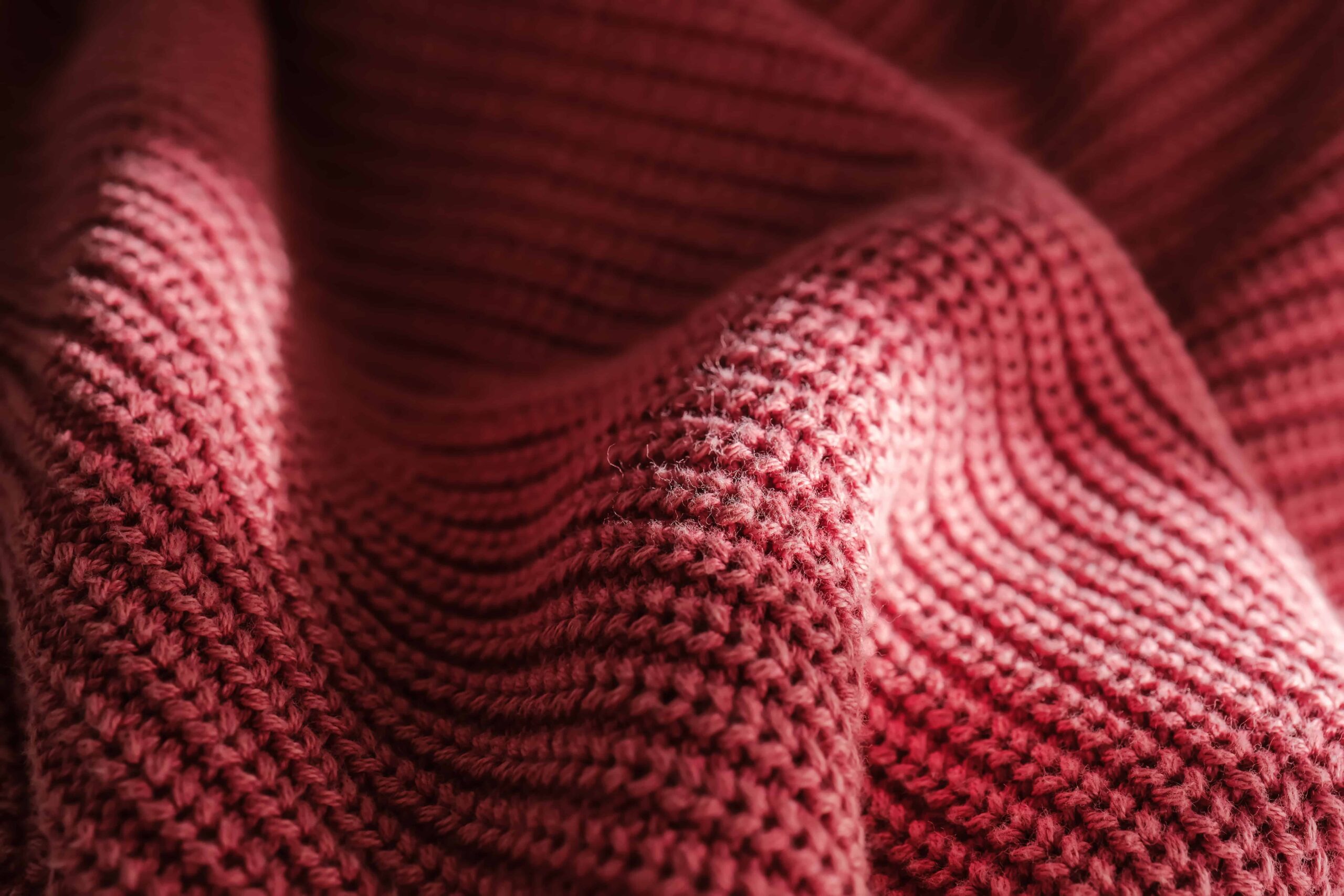
The Three Engineering Levers Behind Every Performance Claim
Every functional property a brand specs for — wicking speed, four-way stretch, breathability — traces back to a combination of these three variables. Understanding them separately is what lets a product developer read a spec sheet critically instead of taking a supplier’s adjectives at face value.
1. Fiber Selection
Synthetic fibers like polyester and nylon behave very differently from natural fibers like cotton when it comes to moisture absorption, drying speed, and stretch potential — polyester is inherently hydrophobic and dries fast, while cotton absorbs moisture readily but holds onto it. Neither is universally “better”; the right choice depends on the garment’s use case. We cover this trade-off in detail in polyester vs. cotton for activewear: which performs better.
2. Yarn Engineering
Before a fiber ever reaches a knitting machine, it’s spun or textured into yarn — and this step can build in capillary channels for wicking, add bulk for thermal insulation, or blend in elastane filaments for stretch. Two fabrics made from the same base fiber can perform completely differently depending on how the yarn was engineered.
3. Knit Structure
The loop pattern and machine gauge determine stretch behavior, drape, opacity, and air permeability. This is the step that turns yarn into fabric, and it’s where constructions like single jersey, interlock, and double knit diverge in performance. The full production sequence — from raw yarn through knitting, dyeing, and finishing — is mapped out in how performance fabric is made: from yarn to finished textile.
Knit vs. Woven: Why Almost All Performance Apparel Starts With a Knit
Wovens are constructed from two perpendicular yarn sets locked at fixed angles, which gives them dimensional stability but very little natural stretch. Knits are built from interlocking loops, which is what gives them inherent stretch and drape without needing elastane at all — though most performance knits add it anyway for stretch recovery. This structural difference is why nearly every activewear, athleisure, and base-layer category defaults to a knit base rather than a woven one, and why wovens are reserved for categories that prioritize structure over stretch (outerwear shells, structured shorts). The full comparison, including where woven still wins, is in knit fabric vs. woven fabric for sportswear: a complete comparison.
The Five Functional Properties Brands Actually Spec For
In practice, “performance fabric” sourcing conversations break down into five concrete, individually testable properties. Treating them separately — instead of as one undifferentiated bucket — is what lets a product developer write an accurate, verifiable tech pack.
| Property | What It Measures | Where to Go Deeper |
|---|---|---|
| Moisture management | How fast sweat is pulled away from skin and spread across the surface for evaporation | What is moisture-wicking fabric? · Product line |
| Breathability | Air permeability through the fabric structure, typically rated in CFM | Breathable fabric product line |
| Stretch & recovery | How far fabric extends under load and how completely it returns to shape | Stretch fabric product line |
| Thermal regulation | Insulation or cooling behavior depending on knit density and fiber | Thermal fabric product line |
| Weight & hand-feel | GSM-driven trade-off between comfort, packability, and durability | Beginner’s guide to fabric GSM |
How to Verify a Performance Claim Before You Commit to MOQ
A functional claim is only as credible as the recognized test method behind it. For moisture management specifically, the industry standard is AATCC 195 — Liquid Moisture Management Properties of Textile Fabrics, which places a sample between calibrated electrical sensors and measures wetting time, absorption rate, and spreading speed on both fabric surfaces (AATCC, Test Method TM195). For stretch and recovery, the relevant standard is ASTM D2594 — Standard Test Method for Stretch Properties of Knitted Fabrics Having Low Power, which measures both fabric stretch under a known load and fabric growth after that tension is released and the sample is allowed to recover (ASTM International, D2594).
When a supplier quotes a wicking speed or a stretch-recovery percentage, it is standard sourcing practice — not an unusual request — to ask which test method and lab produced the number, and when the test was run. Finish-based claims (anti-static, water-repellent, odor control) deserve extra scrutiny because they’re typically applied as a topical treatment layered onto the base knit rather than built into the fiber or structure itself, which means their performance can degrade with repeated washing. Our breakdown of the 5 most common performance fabric finishes covers which finishes hold up long-term and which fade fast.
Common Performance Knit Constructions for Apparel Brands
Most performance apparel is built on a small number of base constructions, and the right one depends on the garment category, not personal preference.
- Single jersey — lightweight, highly stretchable, less structured; common for T-shirts and lightweight base layers.
- Double knit / interlock — more stability, opacity, and shape retention; common for leggings, polos, and structured tops.
- Jacquard knit — patterned structure built directly into the knit rather than printed on afterward, often used where texture or a branded pattern adds value.
The trade-offs between the two most common starting points are covered fully in single jersey vs. double knit fabric: key differences explained.
Reading a Fabric Spec Sheet Like a Buyer, Not a Marketer
Three measurements get confused constantly during sourcing calls, and mixing them up leads to ordering the wrong fabric: denier measures individual yarn thickness (grams per 9,000 meters of fiber); GSM (grams per square meter) measures the finished fabric’s weight; and gauge measures how many needles — and therefore how many yarns — are packed into a given width of the knitting machine. Two fabrics can share the same denier yarn and still land at very different GSM values if they’re knitted at different gauges, because a tighter gauge packs more yarn into the same area. GSM is the metric to check first when comparing fabrics for a specific garment: low-GSM fabrics trade durability for breathability and packability, high-GSM fabrics trade comfort for structure and opacity, and mid-GSM fabrics sit in between for general-purpose activewear.
Market Context: Why Functional Fabric Sourcing Is Getting More Competitive
The global performance apparel market was valued at approximately USD 45.3 billion in 2025 and is projected to reach USD 47.7 billion in 2026, part of a longer growth trend driven by athleisure demand and rising brand investment in technical fabrics (Fact.MR, Performance Apparel Market Report, retrieved 2026-09-11). For apparel brands, that growth means more suppliers competing on functional claims — and more pressure on buyers to distinguish fabrics with genuine, test-backed performance from fabrics marketed with the word “performance” alone.
A Practical Framework for Choosing the Right Performance Knit
Start from the garment’s actual end use, not from a checklist of every available feature. A running top prioritizes moisture management and breathability over stretch recovery; a legging prioritizes four-way stretch and recovery over airflow. Working backward from end use — rather than specifying every performance attribute available — keeps unit costs controlled and avoids paying for functionality your end customer will never notice.
- Define the garment’s primary use case and the one or two functional properties that matter most for it.
- Request test data — method, lab, and date — behind any functional claim, not just a spec-sheet adjective.
- Confirm the base knit construction and fiber blend ratio before requesting a physical sample.
- Order a pilot sample run to validate hand-feel and real-world performance before committing to bulk MOQ.
Frequently Asked Questions
Is performance knit fabric always synthetic?
No. Polyester and nylon dominate the category because of their inherent moisture and stretch behavior, but performance knits can also use natural or blended fibers combined with engineered finishes. See polyester vs. cotton for activewear for how each fiber performs against the same functional benchmarks.
What’s the difference between single jersey and double knit for performance apparel?
Single jersey is lighter, more stretchable, and less structured; double knit offers more stability, opacity, and shape retention. The right choice depends on garment type — full comparison in single jersey vs. double knit fabric: key differences explained.
How do I verify a supplier’s moisture-wicking or stretch-recovery claim before ordering?
Ask for the specific test method — AATCC 195 for moisture management, ASTM D2594 for stretch and recovery — along with the testing lab and test date. A credible supplier keeps this documentation on hand rather than relying only on marketing language.
Does a higher GSM always mean a higher-quality performance fabric?
No. GSM is a weight measurement, not a quality score. Lower-GSM fabrics are the right choice when breathability and packability matter more than structure; higher-GSM fabrics are the right choice when opacity and shape retention matter more. The correct GSM depends entirely on the garment’s use case, as covered in the beginner’s guide to fabric GSM.
Mibein · Global Brand of Xianwei Textile
Looking for a Reliable Fabric Partner for Your Next Collection?
Mibein is a vertically integrated fabric manufacturer with 20+ years of experience, serving apparel brands worldwide from our own facilities in Guangzhou. Tell us what you’re working on and we’ll help you find the right fabric.
Ready color cards · Meter samples · Flexible MOQ for new product programs
Sources: AATCC Test Method TM195 · ASTM D2594 · Fact.MR Performance Apparel Market Report