
Breathable Knit Fabric · Development & Bulk Supply
Breathable Fabric Built Into the Knit Structure
Airflow is a construction decision. Mibein develops breathable knit fabrics where the openness comes from the stitch, the yarn and the way the two faces of the fabric are built, so it's still there after washing.
- Mesh, piqué, double-face & textured knits
- Spun, cationic and hollow-core yarns
- Knitting, dyeing & finishing in our own mill
- Swatches, custom development & bulk
Two meanings, one word
What "Breathable" Actually Means in a Knit
When buyers ask for breathable fabric, they usually mean two different things at once:
Air permeability
How easily air passes through the fabric. This is what you feel when a breeze reaches your skin through a shirt.
Water-vapour transfer
How easily the moisture your body gives off as vapour (before it becomes visible sweat) escapes. This is what stops a garment feeling stuffy at rest.
Fiber plays a part, but most of the difference between two fabrics of the same weight comes from construction: how open the stitches are, whether the knit has holes, ribs or a textured back, and how tightly it is set in finishing. Two 100% polyester knits at 170 g/m² can feel completely different. That's why this page is organized by structure, not fiber. New to the topic? Read how breathability and CFM are measured.
Three different physics
Breathable vs. Moisture-Wicking vs. Cooling
These words are used interchangeably on hangtags, but they describe different physics and are tested differently. A very air-permeable fabric can still feel clammy if it doesn't move liquid sweat; a fabric that feels cold on first touch can still trap heat ten minutes later.
For hot-weather garments, the best results usually come from stacking two of these: an open or textured construction for airflow, plus a yarn that wicks. C25166 below is one example of that pairing.
Openness ranking
Knit Structures and How Each One Moves Air
A starting point for development briefs. It describes relative openness at similar weight, not test results. Click a structure to see how it works.
-
How it lets air through
Tuck or miss stitches leave real holes in the fabric, so air passes straight through.
Trade-offs to plan forCan be see-through in light colours; more prone to snagging. A double-face mesh hides the open side inside.
Mibein examplesC25343 (checkered mesh); XWT1526 birdseye mesh, shown on our moisture-wicking page
-
How it lets air through
Engineered holes in a pattern, usually larger and more visible than mesh.
Trade-offs to plan forA strong visual statement; hole size changes with stretch and setting.
Mibein examplesXWT1527 soft-cotton-feel eyelet (220 g/m²)
-
How it lets air through
A raised cellular surface. The cells hold the fabric off the skin and form small air pockets.
Trade-offs to plan forLess open than mesh; a classic look for polos.
Mibein examplesCustom development
-
How it lets air through
Deep square cells reduce skin contact and hold a thin layer of air.
Trade-offs to plan forHeavier waffles add warmth as well as airflow.
Mibein examplesS35872-2 (waffle back). See our waffle fabric guide
-
How it lets air through
Looser and tighter stitch areas create zones of airflow within one fabric.
Trade-offs to plan forCheck float length for snagging.
Mibein examplesCustom development
-
How it lets air through
Two linked layers. An open or textured back moves air and vapour while the face stays clean.
Trade-offs to plan forMore weight per m²; airflow depends on the back structure.
Mibein examplesC25343, C25171, S35872-2
-
How it lets air through
Fine ribs reduce flat skin contact and stop the fabric clinging when damp.
Trade-offs to plan forModerate airflow; chosen for a crisp look.
Mibein examplesTS25116, C25166
-
How it lets air through
The baseline: thin but closed. Breathability depends mostly on yarn and gauge.
Trade-offs to plan forElastane tightens the knit after heat-setting, reducing airflow.
Mibein examplesY35700
Yarn
The yarn side of the equation
Short fibers with a slightly hairy surface give a cotton-like, dry touch and less cling.
Our AirLume® Y+O fibers: more bulk for less weight, so a fabric can be lighter at the same cover.
Chosen for low-temperature dyeing, two-tone effects and a softer hand. On its own it doesn't add airflow; the structure does.
The range
Breathable Knit Fabrics by Construction
Six qualities grouped by how they create airflow. All are polyester-based; one contains elastane.
Double-face with an open or textured back
Airflow through an open inner layer.
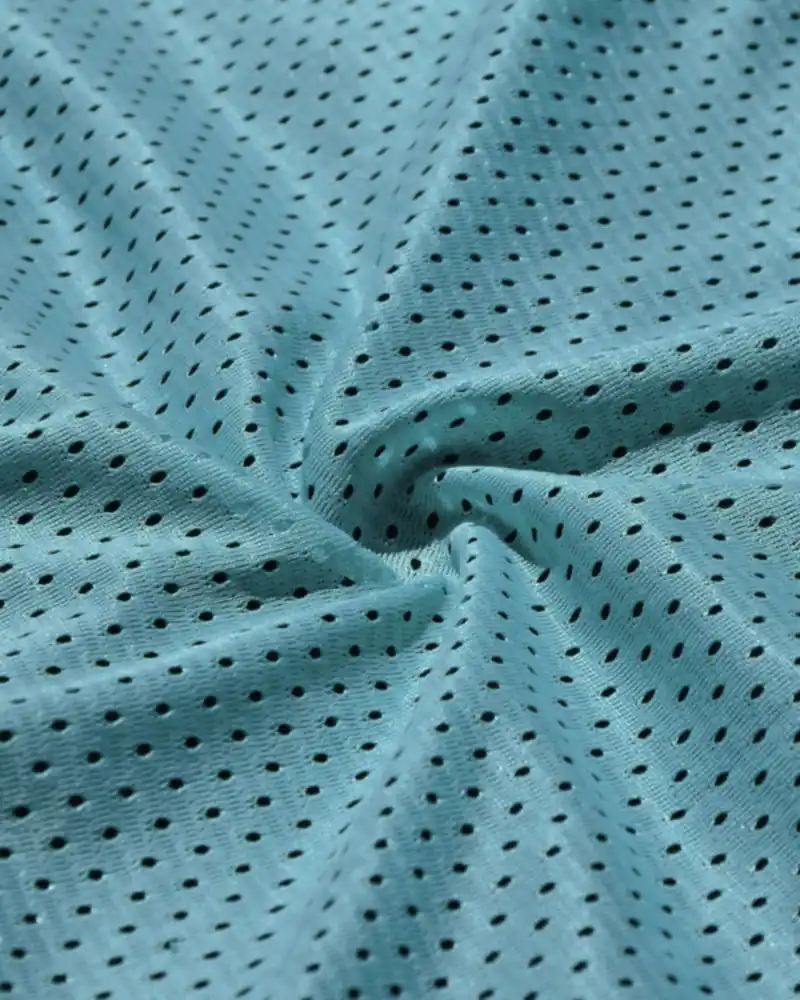
Double-Face Checkered Mesh — C25343
100% Polyester · 155 g/m² · 165 cm
The most open structure in this selection. A double-face build forms a checkered mesh, and a special yarn structure gives a soft, fluffy hand instead of the scratchy feel of plain mesh. Recovery comes without spandex, so the knit isn't pulled closed by elastane.
- Excellent breathability
- Spandex-free recovery
- Fluffy handfeel
- Double-face
Best for: Running long-sleeves and performance tops
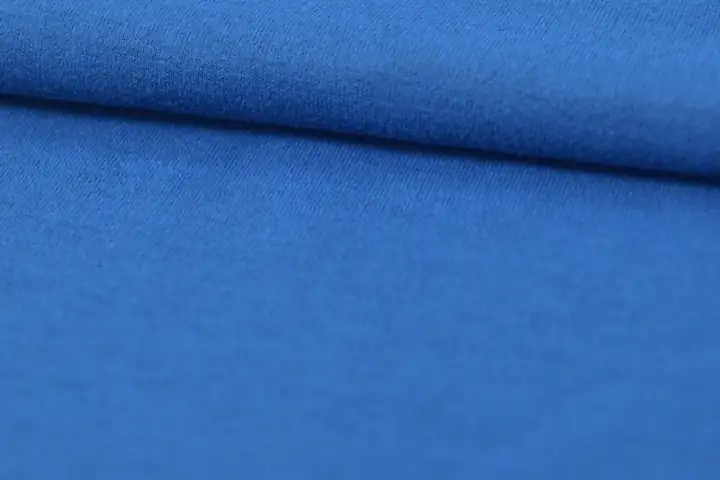
NATURISH Cationic Double-Face Waffle — S35872-2
100% Polyester · 176 g/m² · 164 cm
Spun yarn and cationic filament with a plain slub face and a waffle back. The fine waffle cells hold the fabric slightly off the skin so it doesn't cling, while the face keeps a natural cotton-linen look.
- Breathable
- Dry touch
- Non-cling
- Shape retention

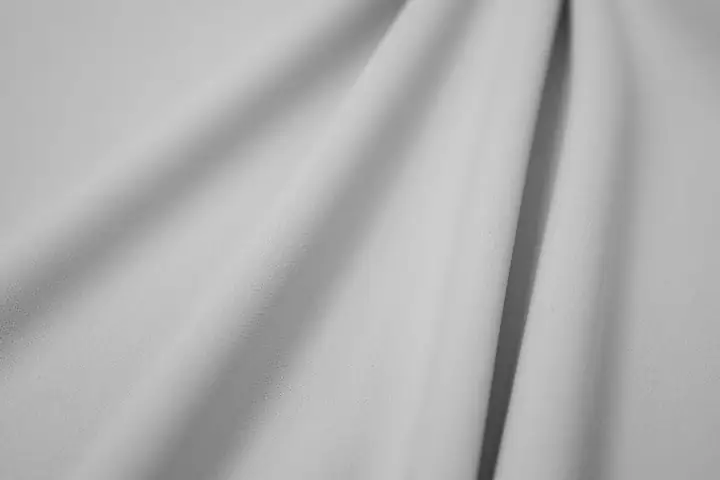
Feather-Yarn Double-Face Knit — C25171
100% Polyester · 170 g/m² · 165 cm
Here the yarn works as hard as the stitch. Feather yarn gives a lofty, fluffy surface, and the double-face structure keeps its shape. A breathable option that looks smarter than a technical mesh.
- Excellent breathability
- Shape recovery
- Fluffy handfeel
- Double-face
Best for: Urban commute tops and smart-casual layers
Horizontal texture and mini stripe
Fine ribs reduce skin contact.
Horizontal Mini-Stripe Knit — C25166
100% Polyester · 135 g/m²
The lightest fabric here. A horizontal mini stripe gives texture without bulk, and the fabric pairs good breathability with moisture-wicking for high-sweat summer tees, where airflow alone isn't enough.
- Good breathability
- Moisture-wicking
- Lightweight
- Clean texture
Best for: Summer T-shirts and premium sports tops
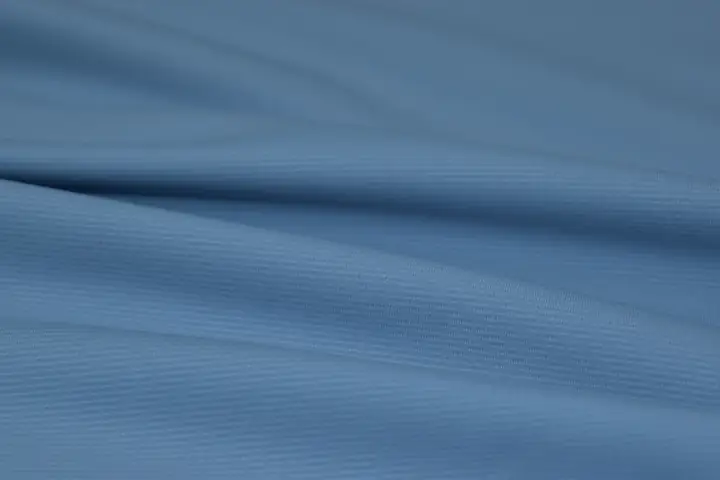
Dry Touch Horizontal-Texture Knit — TS25116
100% Polyester · 190 g/m² · 155 cm
A crisp, dry hand with a horizontal texture. At 190 g/m² it isn't the airiest option here; its value is breathable comfort in a structured fabric that holds a clean line, for sets that would feel stuffy in a dense interlock.
- Breathable comfort
- Dry touch
- Horizontal texture
- Clean structure
Best for: Active sets, urban commute, daily casual
Jersey where the yarn carries the comfort
Closed construction, chosen for soft stretch.
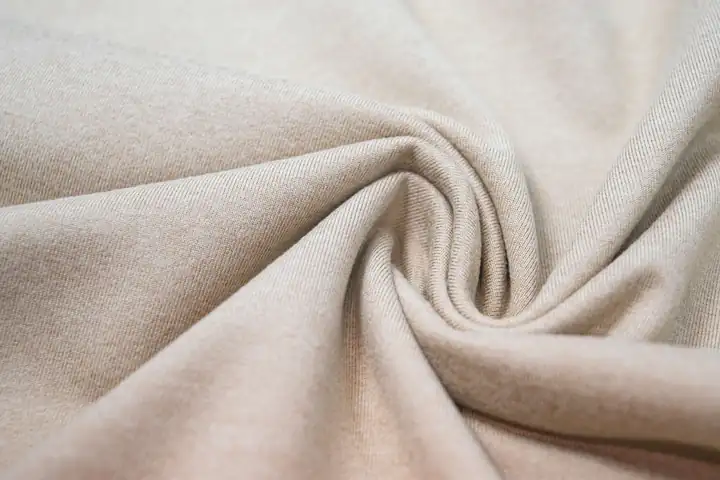
Airslim® Silky-Soft Stretch Jersey — Y35700
84.4% Cationic Polyester / 15.6% Elastane · 230 g/m² · 160 cm
Not an open knit. It's here for buyers who need soft stretch that still feels comfortable rather than sealed. Cationic polyester gives a silky hand and drape; elastane gives stretch and recovery. Expect lower air permeability than the double-face options: the trade-off for close-fitting stretch.
- Breathable comfort
- Stretch & recovery
- Silky soft
- Abrasion resistance
Best for: Active shorts, yoga apparel, loungewear, women's T-shirts
S35872-2, TS25116 and Y35700: Mibein spec sheets. C25343, C25171, C25166: 2026 functional collection brochure. Performance is subject to testing.
The products shown on this website represent only part of our fabric portfolio. Contact us for more fabric options, technical data, color cards, and sample support.
Reading the numbers
How to Read an Air-Permeability Figure
Air permeability is the air flow through a set area of fabric at a set pressure difference. The number means little without its conditions.
More detail: Breathable fabric buyer's guide.
Pressure is not converted. This only changes units. A figure tested at 100 Pa and one tested at 125 Pa are still not like-for-like after conversion.
- Units
ISO 9237 results are usually given in mm/s. ASTM D737 results are often given in CFM (ft³/min/ft²). 1 CFM equals about 5.08 mm/s, so 500 mm/s is roughly 98 CFM.
- Pressure
ASTM D737 is commonly run at 125 Pa, ISO 9237 apparel testing at 100 Pa. Higher pressure pushes more air through, so the 125 Pa figure reads higher on the same fabric. Converting units does not correct for this.
- Conditions and state
Samples should be conditioned (standard atmosphere is around 20–21 °C, 65% RH) and tested at the same area. Greige, finished and washed fabric give different results, because knits relax and tighten after the first wash.
The most common mistake we see is converting one supplier's mm/s into CFM and comparing it with another supplier's CFM as if like-for-like. If one was tested at 100 Pa and the other at 125 Pa, the comparison is skewed from the start. The second is comparing finished-fabric figures with washed-garment figures.
Ask every supplier for the standard, pressure, test area and fabric state, or send all shortlisted fabrics to one lab together.
700+ mm/sOur hollow-fiber hang tag cites 700+ mm/s air permeability for the lightweight hollow-fiber sport fabric it describes. It is a product-data claim, not a figure for the six fabrics above.
By climate and use
Choosing Breathable Fabric by Climate and Use
Hot, humid running and training
Humidity slows evaporation, so airflow and wicking both matter. Choose the most open structure you can accept visually, in a light weight. Start with C25343 or C25166.
Performance T-shirt fabricsDry heat and desert hiking
Sun is often a bigger problem than sweat. Open mesh lets UV through, so balance airflow with coverage and consider yarn-level UV protection.
Hiking T-shirt fabricsOffice and commute
Cold offices, warm streets. Textured and double-face knits such as TS25116, S35872-2 or C25171 breathe without looking technical.
Button-up performance shirt fabricsLayering in changing weather
A base layer must let vapour escape into the mid-layer. Keep light, breathable knits next to skin and add warmth above.
Base layer top fabricsSee also our lightweight fabric and stretch fabric ranges.
Sample to bulk
Keeping Open Structures Consistent From Sample to Bulk
Open and textured knits are the hardest to keep identical across dye lots. On the stenter, extra width opens a mesh up; overfeed and a narrower setting close it down. Weight and airflow move with it, so a fabric approved at one width can test differently at another.
Opens a mesh up
Closes it down
A fabric approved at one width can test differently at another
Knitting, dyeing and heat-setting are done in-house at our own mill, so setting width and temperature are controlled by our own team rather than a subcontractor.
Every dye lot is inspected to the US 4-Point System (100-yard grading).
More for OEM garment factories, or see the mill and lab.
Stock & sourcing
A Ready Fabric Library Behind Every Order
Beyond custom development, we keep 50+ greige fabric qualities in stock, so sampling and bulk orders start faster. Our team follows the market every season and recommends the colors and functional fabrics buyers are asking for.
Ready base fabrics across UV protection, cool touch, quick-dry and stretch, so most programs start from stock rather than from scratch.
Built around your order
Quantities, dye lots and delivery are planned around your program, from first sample yardage to repeat bulk.
Following market trends
We track what sells each season in outdoor, golf and summer active wear, and update the range to match.
Popular colors & functional picks
Tell us your market and price point. Our team recommends the colorways and functional fabrics currently in demand.
Sourcing for a distribution or wholesale program?
FAQ
Breathable Fabric FAQ
Pick a question on the left; the answer opens alongside it.
What is the most breathable fabric?
Construction matters more than fiber. At similar weight, mesh and eyelet knits let the most air through, followed by piqué, waffle and textured double-face knits; plain jersey and dense interlock let through the least. Linen is often called the most breathable natural fiber, but a polyester mesh can move far more air than a dense cotton.
Is polyester breathable?
Polyester fiber absorbs very little moisture (standard moisture regain of about 0.4% in ASTM D1909, versus about 8.5% for cotton), but breathability depends mostly on structure. An open or textured polyester knit lets air and vapour through and moves sweat instead of holding it; a dense, heavy one can feel stuffy. Polyester vs. cotton for activewear.
What is the difference between breathable and waterproof fabric?
Air-permeable fabric lets air and water through; waterproof fabric blocks liquid water. "Waterproof-breathable" fabrics use a membrane or coating that blocks rain and air but lets water vapour escape. The knits on this page are air-permeable apparel fabrics. They are not waterproof.
How is fabric breathability measured?
Air permeability measures airflow at a set pressure: ASTM D737 (often in CFM) or ISO 9237 (mm/s). Water-vapour transfer is measured by ISO 11092 (Ret; lower is more breathable) or ASTM E96 (transmission rate). Only compare results from the same standard and pressure.
Is mesh the most breathable fabric?
Mesh usually has the highest air permeability for its weight because it has real holes. It can also be see-through in light colours, snag more easily and let more UV through. A double-face mesh, open inside and closed outside, keeps much of the airflow with a cleaner look.
What is the best breathable fabric for summer?
Look for a light weight, an open or textured structure and a yarn that wicks, so the fabric handles airflow and sweat. For example, C25166 (135 g/m², horizontal mini stripe, breathable and moisture-wicking) suits summer tees, and C25343 (155 g/m², double-face checkered mesh) suits running tops.
Does breathable fabric keep you cool?
It helps by letting body heat and vapour escape, but it doesn't feel cold on its own. Cool-to-touch is a separate property, measured by contact-cooling tests. For hot weather, combine breathability with wicking, and add cool touch or sun protection where needed.
Does elastane make a fabric less breathable?
Usually, yes. Elastane pulls the knit together during heat-setting, so stretch jerseys tend to be denser. That's why Y35700 is positioned for soft-stretch comfort rather than maximum airflow. Spandex-free constructions such as C25343 keep more of their openness.
Start a brief
Brief Us on Airflow, Not Just "Breathable"
Tell us the garment, the climate, your target weight and how open the fabric can look. We'll suggest constructions from the range above or propose a development, and send swatches with spec sheets.
- Garment
- Climate
- Target weight
- How open it can look