

Dropping fabric weight always costs you something. Here’s what you actually trade away at each GSM step, and where it stops being worth it.
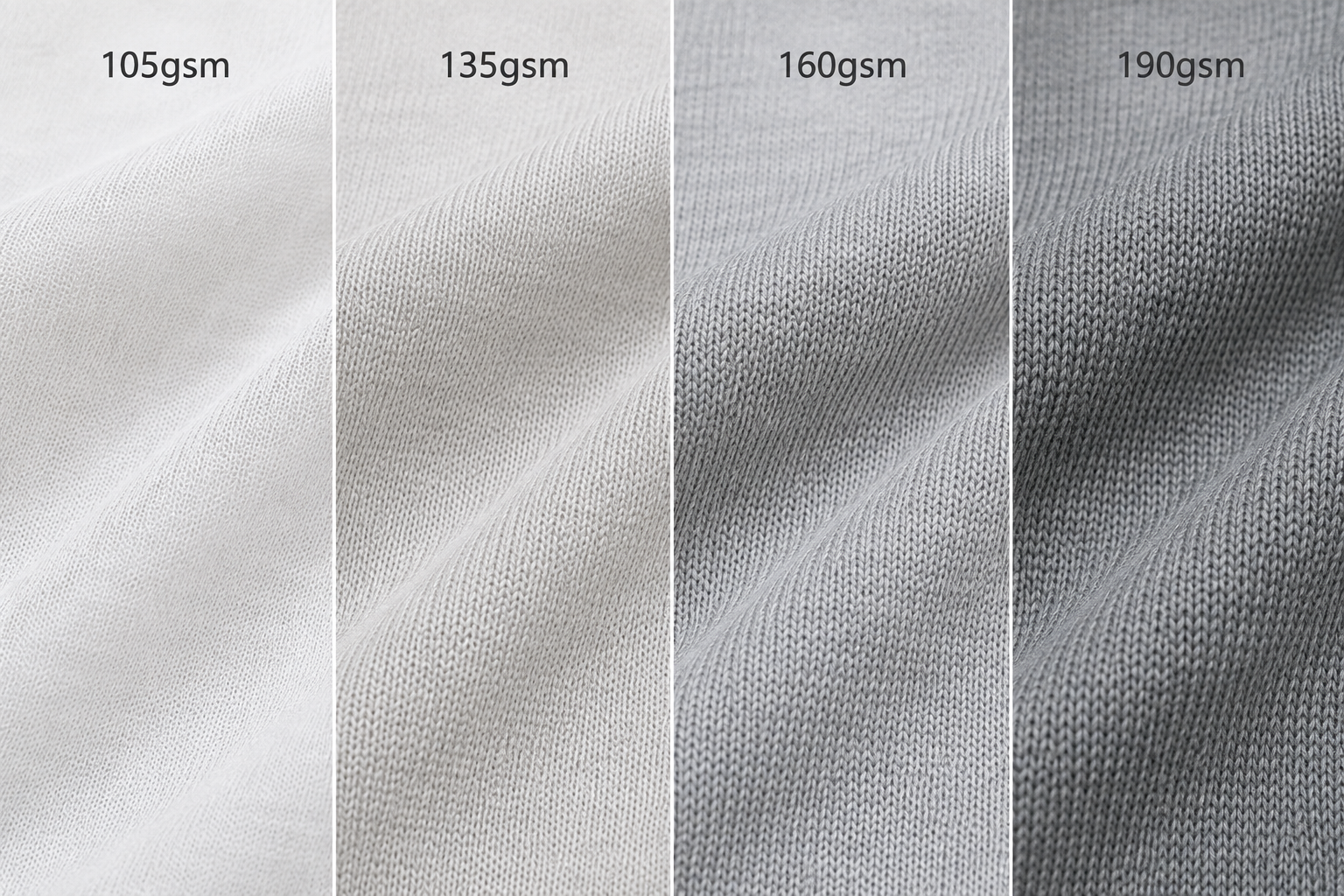
Short answer: lightweight performance knit typically runs 105–190 g/m². Below about 130 g/m² you start trading away pilling resistance and opacity for weight savings — the right number depends on what the garment needs to survive, not on chasing the lowest GSM possible.
Key Takeaways
- “Lightweight” for performance knit generally means 105–190 g/m² — below that, most fabrics stop behaving like everyday apparel fabric.
- Every GSM drop trades something away: pilling resistance, opacity, or seam strength, depending on construction.
- Fiber choice matters as much as weight — a 105 g/m² conductive-fiber fabric solves a completely different problem than a 150 g/m² standard polyester at a similar weight.
- For general GSM tiers across all weight classes, see Fabric Weight Guide: Lightweight, Midweight, Heavyweight — this guide picks up from there.
What Makes a Fabric “Lightweight”?
In performance knit fabric, “lightweight” generally means roughly 105–190 g/m² (GSM) — light enough to reduce body burden and layer easily, but still within a range that holds up as real apparel fabric rather than a sheer, single-use textile. For the full breakdown of how lightweight compares to mid- and heavyweight tiers, see the Fabric Weight Guide. This guide goes one layer deeper: what you actually give up as the number drops, and how to pick the right point in that range.
A quick GSM primer — useful context before the trade-off discussion below.
The Weight-Durability Trade-Off Nobody Talks About
Most lightweight fabric content stops at “lighter feels better.” It doesn’t explain what you’re trading away to get there:
- Pilling resistance — thinner yarns at very low GSM show surface wear faster under friction.
- Opacity — dropping weight for a light-colored garment increases see-through risk long before it becomes a comfort problem.
- Seam strength — very light fabric needs construction adjustments at stress points, or seams fail before the fabric does.
Real Lightweight Fabric Specs (105–190 g/m²)
| Item | Weight | Composition | Best for |
|---|---|---|---|
| Y35749 | 105 g/m² | 100% Polyester, conductive fiber | Anti-static, ultra-light layering |
| TS25166 | 135 g/m² | 100% Polyester, UPF50+ | Sun-exposed lightweight apparel |
| Q35572 | 150 g/m² | 100% Polyester | Everyday lightweight tees, shirts |
| S35817 | 190 g/m² | 100% Polyester | Upper end of “lightweight,” more structure |
Anti-Static Lightweight Fabric: A Real Gap
Static cling gets worse, not better, as fabric gets lighter — thinner, more tightly packed synthetic fibers generate more friction-based charge. Mibein’s 105 g/m² option (Y35749) addresses this directly with a conductive fiber woven into the construction, rather than a topical anti-static spray that washes out. It’s a narrow technical need, but one almost no lightweight-fabric content anywhere addresses.
Lightweight Fabric by Garment Type
The right weight shifts by end use. A lightweight jacket needs to compress into a bag and spring back without staying flat. A lightweight travel pant needs to survive hours of continuous sitting. A lightweight base layer needs to disappear against skin during movement. None of these want the same GSM.
Verifying a Supplier’s Weight Claims
Fabric weight has an actual test standard — ASTM D3776, Standard Test Methods for Mass Per Unit Area (Weight) of Fabric — so “lightweight” or “ultra-light” printed on a spec sheet with no GSM number attached is a marketing description, not a specification. Ask for the tested GSM figure and the fiber composition as a percentage; both should come back within a day from a supplier testing in-house.
Not sure which weight fits your garment?
Send Mibein’s team your garment type and target durability requirements, and we’ll recommend the GSM and fiber that actually match the brief.
Start Fabric Development