

Anti-Static Conductive Fabric Explained: Warmth, Featherlight Feel & Static-Free Wear
Warmth without weight. Comfort without static. The black-tech fabric that protects against the cold — and the crackle.
What Is Anti-Static Conductive Fabric?
Anti-static conductive fabric is a warmth-focused textile that solves a problem most thermal wear ignores: static electricity. In dry winter environments, synthetic insulation fabrics generate friction charges that cling, crackle, and attract dust. This fabric is engineered so that the very structure that traps heat also dissipates charge — warmth and static-free comfort in one.
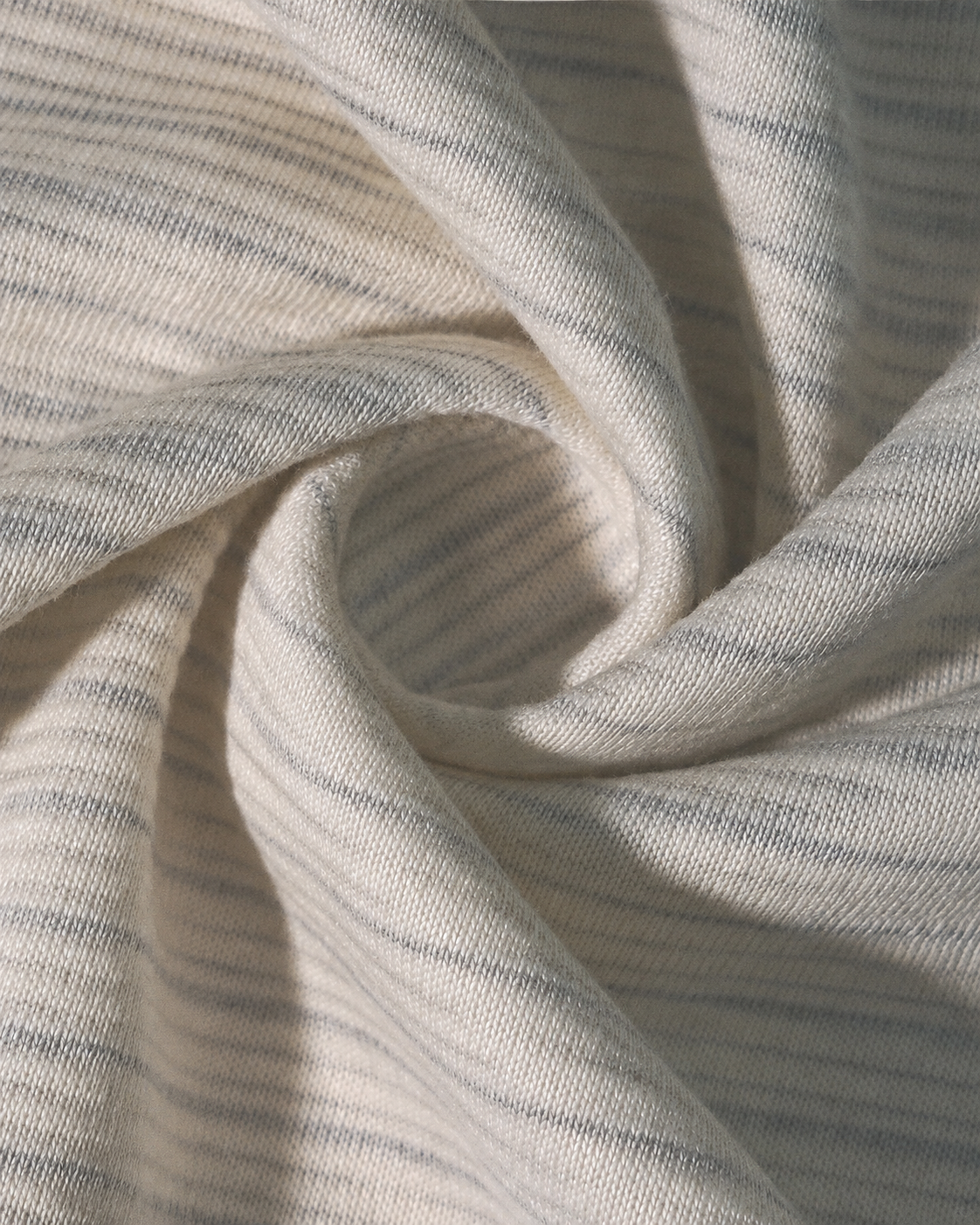
The technology builds on established principles of static electricity control in textiles: conductive elements embedded in the yarn network continuously drain charge before it accumulates, keeping the wearer’s skin and garment clean and comfortable.
The Yarn: Hollow-Fiber Engineering
The Structure: Mesh-Woven Thermal Body
The fabric is built on a warp-and-weft mesh weave that creates a voluminous body. The surface layer carries fine micro-pile particles that enhance light diffusion — a soft, matte, premium appearance. The base layer’s interlocking channels promote balanced heat-and-moisture exchange, so the body stays warm without trapping sweat.
Embedded within this structure, static-dissipating yarns are distributed in a grid pattern, interrupting the charge-accumulation path across the entire surface. Heat and charge management work simultaneously, not as competing functions.
Performance #1: 2x Thermal Resistance
The hollow-core structure delivers genuine measurable warmth: thermal resistance up to twice that of conventional fabrics. The trapped-air layer slows heat transfer while the mesh structure retains body warmth. For extreme-cold protection, this means more warmth per gram of fabric — the core requirement of high-performance cold-weather gear.
Performance #2: Featherlight Feel
Ultra-fine denier + vortex spinning + hollow core = a fabric that mimics the buoyancy of down. Wearing weight approaches zero. You get insulation that feels like you are wearing nothing at all — the “feather effect” that makes lightweight thermal layering possible. For travelers and outdoor users, this directly translates to packability and all-day comfort.
Performance #3: Ion-Conductive Anti-Static
Instead of relying on surface coatings that wash away, this fabric’s ion-conductive system eliminates friction charge at the fiber level. Charge generated by movement is conducted away and dissipated continuously, keeping the skin’s microclimate fresh. No static cling against the body, no dust attraction, no winter crackle when you remove the garment. Antistatic textile treatment research confirms that fiber-integrated conductivity outperforms topical finishes for durability.
Applications: Extreme Cold to Skin Contact
| Application | What the Fabric Delivers |
|---|---|
| Composite insulation lining | Laminates with functional fabrics as thermal lining — ideal for extreme-cold protective gear |
| Next-to-skin garments | Cotton-soft, skin-friendly surface that avoids friction sensitivity |
Why These Three Work Together
FAQ
What is anti-static conductive fabric?
It is a warmth-focused textile with embedded conductive elements that dissipate static charge, combining hollow-fiber insulation with ion-conductive anti-static performance.
How does it provide warmth without weight?
Ultra-fine denier fibers with hollow cores trap still air — the best insulator — delivering up to 2x thermal resistance while keeping wearing weight near zero.
Does the anti-static function wash out?
No. The conductive system is embedded in the yarn network (not a surface coating), so charge dissipation continues through repeated washing and wear.
Is it suitable for extreme-cold protection?
Yes. Its 2x thermal resistance makes it an excellent thermal lining when laminated with functional outer fabrics for cold-weather protective equipment.
Can it be used against the skin?
Yes. The molecular-level surface treatment provides a cotton-soft touch that avoids friction sensitivity in next-to-skin garments.